Showing posts with label Artists. Show all posts

Saturday, 1 April 2017

Tate Liverpool And Crosby Beach

Tate Liverpool and Antony Gormley's 'Another Place'


The first place we visited when arriving at Liverpool was Crosby Beach, which doubles as Antony Gormley's extensive installation, 'Another Place'. The installation is made up of 100 cast iron figures that stretch across the length of the beach, and have been places out as far as the tide would allow, so that as the tide comes in, man of the sculptures vanish under the waves.

The piece toured several locations in Europe, the first location being Cuxhaven in Germany in 1997, before finding permanent residence at Crosby Beach in 2007 after much dispute.


We arrived at Crosby Beach at around 10:30, and had been granted a whole two hours to wander across the beach and take in the sculptures. It was a less than ideal time however, because within half an hour of being there, much of the beach was soon swallowed up by the tide. I did however, manage to see 3 of the 100 sculptures up close.


The sculptures were unusual to witness. Each one was numbered, and had limited detail because of them being a body cast. Where nipples might have been were huge, flat, rivet like circles.
Every one of the sculptures I saw was mottled with rust and algae.
From a distance, seeing all of the solid and un-moving silhouettes of people was a little unnerving, even more so was seeing the sculptures vanish into the water when the tide came in.
Out of the three I saw, I considered myself luck to come across one that was wearing a t-shirt.

I enjoyed my time there, and while I wasn't able to walk around for longer than I had, I was still able to see the installation from the path than ran alongside the beach.
I liked that these lumps of iron were forever changing when the tide came in, or when someone came and dressed them up. The idea that such a solid material could be changed was intriguing, even if it didn't inflict change upon the actual material itself, the installation was in such a place that the environment would be forever changing, and would never be the same twice.


The second place we visited was the Tate Liverpool, which I had been to years previously, but had less than fond memories of the place in general.
This time round with myself being a lot more mature and aware of the artwork I was going to see, as the last time I had visited was five years ago, I could definitely appreciate the artwork a lot more. As I have been researching this year, I had even studied an artist who's work I had taken interest in those five years ago.
As I walked around the galleries, I was shocked at how many pieces I saw within this small gallery who's creators I have been researching throughout the past year. Phyllida Barlow's paintings which I have never seen in person before hung on a wall in one of the spaces, directly across from Rachel Whiteread's 'Untitled (Air Bed II)' (1992) and Rebecca Warren's 'Versailles' (2006).


While most of the gallery spaces were off limits because new exhibitions were being installed, there was quite a lot to see in the three rooms we were able to go into. A lot of the things caught my attention, whereas the last time I went, I would have walked around the room and not paid attention.

The best part about going to this gallery was the fact that not two years ago I didn't like the idea of contemporary art, but now it is what my focus is on. I would have ignored and mocked pieces because it wasn't what I considered being art, nor what I had been taught was art throughout my time in secondary school art. This visit allowed me to see how close minded I was a few years back, and to see how far I had come as a more mature person and artist within those years.

Friday, 3 March 2017

Artist Reference

Andy Goldsworthy


Born in 1956, Cheshire, England, Andy Goldsworthy is a British Sculptor, Photographer and Environmentalist who produces site specific sculpture and land art situated in natural and urban settings. He has created work at the North Pole, in Japan, the Australian Outback, the U.S and many other places.
His goal is to understand nature by directly participating in nature as intimately as possible, and generally works with whatever items he finds; Leaves, twigs, ice, snow, stone, reeds, and thorns are some of his materials.
Currently, he lives and works in Scotland.

From the age of 13, he worked on farms as a labourer, and has often compared his way of working to that of the tasks you would do on a farm.
He studied Fine Arts at Bradford College of Art from 1974 to 1975, and then at Preston Polytechnic from 1975 to 1978. In 1993, he received an honorary degree from the University of Bradford, and was an A.D White Professor-At-Large from 2000 to 2006, and from 2006 to 2008.

Photography plays a crucial role in Goldsworthy's work because of its often ephemeral and transient state. He records his work as and before they disappear using his photography.

He is represented by Galerie Lelong, New York and Paris.

http://www.boredpanda.com/land-art-andy-goldsworthy/

http://visualmelt.com/Andy-Goldsworthy

http://www.morning-earth.org/ARTISTNATURALISTS/AN_Goldsworthy.html


Artist Reference

Phyllida Barlow


Phyllida Barlow is a British artist who was born in Newcastle-Upon-Tyne in 1944. Despite being born in Newcastle-Upon-Tyne, she was brought up in London.

She studied at Chelsea College of Art from 1960 to 1963, and then at Slade School of Art from 1963 to 1966. While studying in Chelsea, Barlow was under the tutelage of George Fullard, who influenced her perception of sculpture. She also met her husband, fellow artist Fabian Peake.
In the late 1960's, she joined the staff of Slade School of Art, and taught there for over 40 years until 2009 when she retired and became an Emerita professor of Fine Art. Some of her students included Turner Prize winner, Rachel Whiteread, and Angela de la Cruz.
In 2011, she was made a Royal academician, and made a CBE in 2015.

She will represent Britain at the 2017 Venice Biennale.

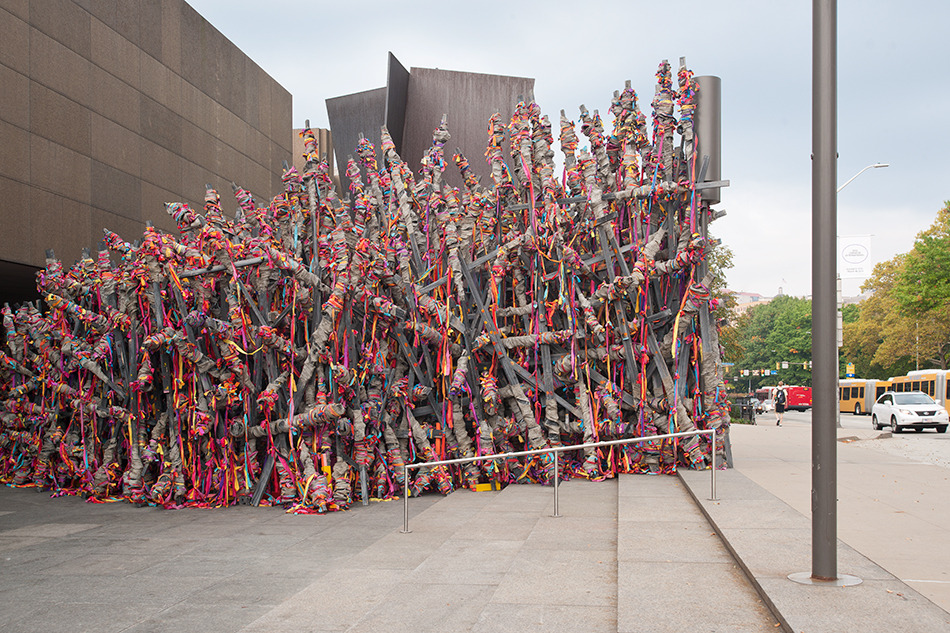
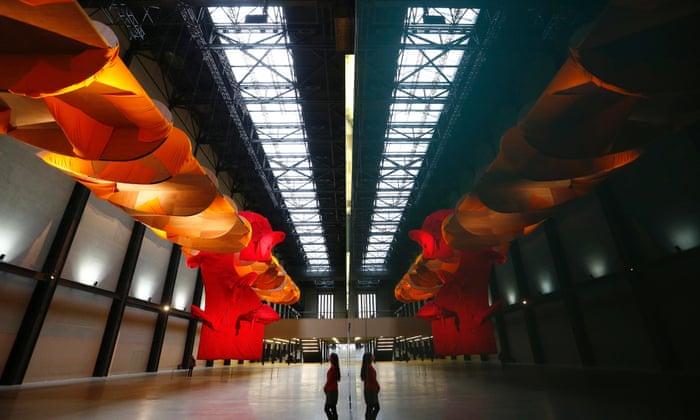
Barlow is best known for her colossal sculptural projects and use of 'throw-away' materials such as plywood, cardboard, plaster, cement, fabric and paint amongst other things. Her practice is grounded in an anti-monumental tradition characterized by her physical experience of handling materials which she transforms through the process of layering, accumulation and juxtaposition. Her sculptural objects are often arranged in complex installations that seem very unbalanced. She locates them in such a way that they block, interrupt and intervene, both dictating and challenging the experience of viewing. 
Her constructions are often crudely painted in industrial or synthetic colours, resulting in abstract seemingly unstable forms. In the past she would leave her works in the street to see what happened to them, or break into a disused factory and install something nobody could see.
Barlow is fascinated with the physicality of creating things, from breaking, sawing, cutting, coiling, folding or covering. She even prefers the process more than the finished product, and compares the construction process of her work to that of a performance that something slowly emerges from.

Since 2010, she had been represented by Hauser & Wirth.

http://ci13.cmoa.org/artists/phyllida-barlow

http://www.telegraph.co.uk/art/artists/sculptor-phyllida-barlow-gets-cbe-for-services-to-art/

https://www.a-n.co.uk/news/artist-rooms-louise-bourgeois-and-phyllida-barlow-at-tate-modern

Saturday, 25 February 2017

Using My Research

Pieces Inspired By Artists


After researching into artists such as Patrick Heron and Dylan Gebbia Richards, and after experimenting with one coat plaster, I thought it would be best to move away from creating sculptures that stood tall, as I found myself creating the same type of things I had been making a year previously. I wanted to experiment with creating reliefs, which meant that I could still experiment with making sculpture, just in a different manner. 

I started my new sculptures by making a flat slab of plaster using the cottling technique. This technique means that you can get smooth lines and can create a slab of any size or thickness to your liking. I chose to do this because I felt that using cardboard as a base which I had done before would get too soggy and wouldn't be strong enough to hold the amount of plaster i planned to put onto it. Whereas if I were to use a solid base made out of the same material, as long as I made a good batch of plaster, it would be strong enough to hold the weight.


Unfortunately, the first batch of plaster never set properly, and rather than letting it go to waste, I used my research into Patrick Heron, and experimented with his choice in colouring and his technique.
Heron would create abstract pieces using information of his surroundings to create resemblances of what he remembered, rather than looking at the object in front of him. So I started looking for things that were in my vicinity, but rather than paying attention to drawing them accurately, I just scratched a simple and abstract shape of the object into the plaster.

As I painted the background, I realised that I didn't really like the colour combination I had chosen, and that it didn't really turn out as planned, and rather than painting just the inside of the shape, which I felt would have been boring, I chose to use a bright yellow to stand out from the dark green and blue to draw the outline of each shape.

I used a small amount of blue to fill in circles in particular, and in any other places I felt were over powered by the yellow. I also used red to fill in most of the lines. When filling in the shapes with colour, rather than filling them in neatly, I decided to apply the paint unevenly so as to add some dimension back into the plaster.


After this, I attempted to use the cottling method again, but this time, making the plaster uneven on the surface, particularly on the corners. Thankfully, this batch of plaster set properly, and so I was able to work properly on it.
For this piece, I had been looking at an artist who created texture by adding different layers upon layers of colours. I started with a base of three colours, which were given texture by mixing the paint with sand. Each different colour had a different thickness so that they would all apply differently.


For this piece, I plan to keep building it up using different colours. The way I plan to apply the colour is by watering down paint, and spraying it from the underside of the bumps created by the mix of paint and sand, so that it will enunciate only the underside of the texture.


Monday, 6 February 2017

Artist Research

Dylan Gebbia Richards


Dylan Gebbia Richards was born in Conneticut, and when younger, was obsessed with meteorology and rivers. He often gave weather reports when in school, and posted reports on notice boards around hi school.

Gebbia Richards creates large sculptures and sculptural paintings, and is known for building off of his prior piece.

He creates his own materials to work on, with the example of 9 in Series.

He uses latex based acrylic paints.

http://csartcolorado.org/artist-profile-dylan-gebbia-richards/
http://www.dylangebbiarichards.com/
http://cuart.colorado.edu/degrees/undergraduate/ba-studio-art/

Artist Research

Patrick Heron


Patrick Heron is a British born Abstract and Figurative painter born in 1920.
His work was influenced by Paul Cézanne, who's paintings he first saw when on a school trip to the National Art Gallery in London in 1933. He began painting in a similar style to Cézanne afterwards.
At the age of 17, he attended the Slade School Of Art for two days every week,

In World War II, he registered as a conscientious objector, and worked as an agricultural labourer for three years, and then at the Leech Pottery in St. Ives between 1943 and 1944, where he met artists such as Ben Nicholson and Babara Hepworth, and many other leading artists, who attended the St. Ives School.
In 1943, he completed his first mature work 'The Piano' shortly after seeing Matisse's 'The Red Studio' at the Redfern Gallery.

Heron's writings about art began in 1945, when he was invited by Philip Mairet, the editor of The New English Weekly to contribute to the journal. His first published article was on Ben Nicholson, followed by essays on Picasso, Klee, Cézanne, and Braque.
Two years after, he became the art critic for the New Statesman until 1950. He also became the London correspondent to Arts Digest, New York.

In 1947, Heron began painting a series of portraits of T.S.Eliot.
His garden paintings of 1956 marked a singular achievement within the British Period of Art.

http://www.tate.org.uk/art/artists/patrick-heron-1278

Wednesday, 1 February 2017

Artist Research

Rachel Whiteread


Whitehead is an English artist who primarily produces sculpture. She was born in 1963 in Ilford, Essex. 
At the age of 7, she moved to London with her family. 
She studied at the Faculty of Arts and Architecture in Brighton Polytechnic from 1982 to 1985. She graduated with a BA in painting. but spent much of her time producing sculpture. 
She took a workshop with the sculptor Richard Wilson, and began to realise the possibilities of casting objects. From 1985 to 1987, she studied sculpture at Slade School of Art, University College, London, graduating with an MA. 

For a time, she worked in Highgate cemetery fixing lids back onto time-damaged coffins. 
In 1987, she began to exhibit her works, and in 1993, she was the first woman to win the annual Turner Prize.
Many of her casts are of ordinary domestic objects, and in numerous cases, are of their negative spaces. She is also known for creating solid casts of the open spaces in and around pieces of furniture, such as tables and chairs, architectural details, and even entire rooms and buildings.
She says that the casts carry "Residue of years and years of use."
She mainly focuses on the line and form of her work.

She currently lives and works in a former synagogue in east London.

House - 1993
https://www.apollo-magazine.com/house/
Untitles (Stacks) - 1999
https://www.pinterest.com/explore/rachel-whiteread/
Untitled (One Hundred Spaces) - 1995
https://uk.pinterest.com/pin/292171094557423571/


Tuesday, 10 January 2017

Artist Research

Oskar Schlemmer


Schlemmer was bon in 1988 in Stuttgart, Germany. He was a German painter, sculptor, designer, and choreographer associated with the Bauhaus. 

Schlemmer was completely independent by 1903 after the death of his parent around 1900. He supported himself as an apprentice at an inlay workshop, moving on to another apprenticeship in marquetry from 1905 to 1909.
He studied at the Kunstgewerbeschule, as well as the Academie der Bildenden Künst in Stuttgart, under the tutelage of Christian Landenberger and Fredreich Von Keller.
He moved to Berlin, where he painted she of his most important works before returning to Stuttgart as Adolf Hölzel's master pupil. In 1914, he was enlisted to fight on the Western Front during WW1 until he was injured and moved to a position with the military cartography unit in Colmar, where he resided until returning to work under Hölzel in 1918. In 1919, he turned to sculpture.

In 1920, he was invited to Weimar by Waler Gropius to run the mural-painting and sculpture departments at the Bauhaus school before heading up the theatre workshop in 1923.
Schemers ideas on art were complex and challenging even for the progressive Bauhaus movement, yet they were influential, making his one of the most important reachers at the school at the time.
In 1929, he resigned his position with the arrival of the radical communist architect, Hannes Meyer, Walter Groupius' successor. He took up a job at the Art Academy in Breslau.
He became internationally known because of "Triadisches Ballet" in Stuttgart in 1922. Some of his other works were "Slat Dance" and "Treppenwitz" in which performers became living sculptures.
His work for the Bauhaus and preoccupation with the theatre are an important factor in his work, which deals mainly with the problematic of the figure in space. While at Bauhaus, he developed a multi-disciplinary course called "Der Menach" (The Human Body).
After using Cubism as a springboard for his sculptural studies, his work became more intrigued with the possibilities of figures and the relationship to the space around them, for example, "Egocentric Space Lines" 1924.

beginning in 1929, he executed settings for the opera "Nightingale" and the ballet "Renard" by Igor Stravinsky.

At the art academy in Breslau, he painted on of his most celebrated woks, "Bauhaustreppe" (bauhaus Stairway).
He was obliged to leave Breslau Academie when it closed down in the wake of the financial crisis following the Wall Street Crash. He took up professorship at Berlin's Vereinigte Staatssuchlen Für freie Angewandere Kunst (United State School for Fine and Applied Arts) in 1932, but was pressures in 1933 to resign by the Nazi's. 
His work was displayed in the "Degenerate Arts" exhibition.


Artist Research

John Ernest


Born in 1922 in Philadelphia, America, John Ernest was an American Constructivist- Abstract painter. 
After working in Sweden and Paris from 1946 to 1951, he moved to London were he continued to work. He became a mature student at Saint Martins School of Art, and came under the influence of Victor Pismire. 
During the 1950's together with Anthony Hill, Kenneth Martin, Mary Martin, Stephen Gilbert, and Gillian Wise, he became a key member of the British Constructivists. 

He created both reliefs and free standing constructions. He had a lifelong fascination with mathematics, which is reflected in his work. 
He and Anthony Hill made contribution to graph theory.


Artist Research

Jeffrey Steele


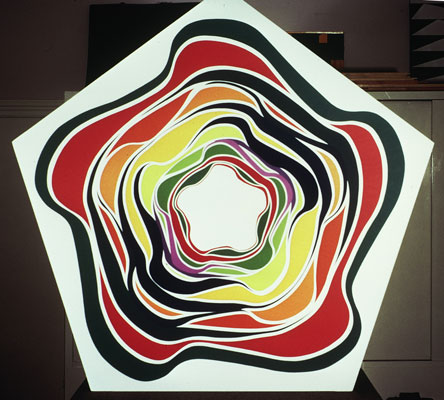
Jeffrey Steele was born in 1931 in Cardiff. He was an Abstract Painter. He encountered works of Geometric Abstraction by artist such a Victor Vasarely, Max Bill, and Josef Albers, and adopted the lifelong abstract approach.
For 8years, he produced work purely in black and white, and was identified with the Op Art Movement. He incorporated other colours into his work in the 1970's.
His work has been exhibited in London, Paris, new York, Milan, and at the Venice Bienalle in 1986.
He ha participated in more that 100 group exhibitions, and has had over 17 solo exhibitions.


Artist Research

Louise Bourgiose


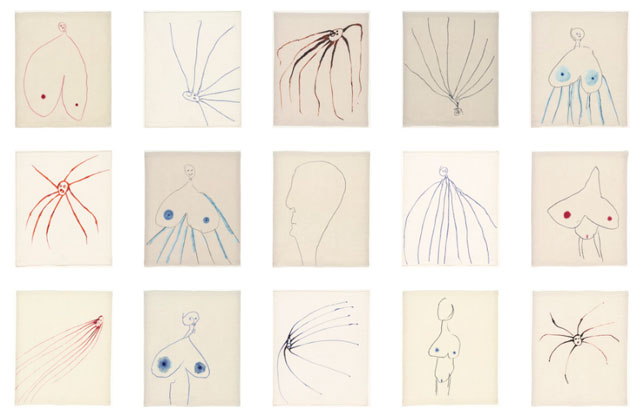
Louise Bourgiose was born in Paris, France, in 1911. She was a French-American artist best known for her large scale sculptures and installations. She was a prolific painter and printmaker.
She studied a variety of themes over the course other long career, such as domesticity, family, sexuality and the body, as well as the subconscious. 
While she exhibited her work with the Abstract Expressionists, and hd much in common with the Surrealists and with Feminist Art, she wasn't formally associated with any particular artistic movement. 

Her parents ran a gallery, and dealt mostly with antique tapestries.
A few years after her birth, her family moved out of Paris and set up a workshop for tapestry restoration, for which Bourgiose filled in the designs were they had become worn.
As a child, Bourgiose did not meet her fathers expectation for lack of ability, but was loved nonetheless for her spirit and talent. However, throughout her childhood, she continued to the her father for is explosive temper, domination of the household, ad for teasing her in front of others.

In 1930, she entered the Sorbonne to study maths and geometry, which she valued for their stability. Her mothers death in 1932 inspired her to abandon maths, and study art. Her father refused to support her. 
She continued to study at art classes, where he was told by Fernard Léger she wasn't a painter, but a sculptor.

She graduated Sorbonne in 1935, and began studying art in Paris. 
Bourgiose had a desire for first hand experience, and frequently visited studios in Paris, learning techniques from the artists and assisting with exhibitions. 
She briefly opened a print shop next to her fathers tapestry workshop. Her father would help her as long as she entered into a commerce driven profession. It was here that she met her husband, Robert Goldwater. They later got married and emigrated in 1938 to New York, where Bourgiose attended the Art Students League of New York, studying painting under Vaclav Vytlacil, also producing sculptures and prints. 
For Bourgioe, the 1940's represented the difficulties of a transition to a new country, and the struggle to enter the exhibition world of New York. 
In 1954, she joined the American Abstract Artists group, where she befriended artists such as Bennett Newan, Al Reinhardt, mark Rothko, Willem De Kooning, and Jackson Pollock.


Artists Research

El Anatsui


El Anatsui is a Ghanian sculptor active for much of his career in Nigeria born in 1944. He creates distinctive large scale assemblage of thousands of pieces of aluminium sources from alcohol nations, sewed together with copper wire.
His sculptures "draw connections between consumption, waste, and the environment."
He as born in the Anyako, the Volka region of Ghana, and trained at the College Of Art, University of  Science and Technology in Kumani, central Ghana.
He began teaching at the University of Nigeria, Nsukka, in 1975, and became affiliated with the Nsukka group.


Artists Research

Richard Tuttle


Tuttle was born in 1941, Rahway, New Jersey. He is an american post-minimalist known for is small, subtle intimate works. His art makes use of scale and line. 
He works with sculpture, painting, drawing, painting,printmaking, furniture, installation, and books.

He studied Philosophy and Literature Trinity College in Hartford, Connecticut from 1959 - 1963, and moved to New York after receiving his BA, where he spent a semester at the Cooper Union, and a brief stint in the U.S air force.
He worked at the Betty Parsons Gallery, and after working as Betty Parsons' assistant, she gave him his first show in 1965. 
Hi work was embraced quicker in Europe than in America.
He is often referred to as an Artists' artist, as his work influenced a generation of contemporary artists, such as Kiki Smith, Jim Hodgens, David Hammons, Michael Oman-Reagan, Tom Friedman, and Jessica Stockholder. 
He was a close friend of Minimalist painter Agnes Martin, until her death in 2004.


Artist Research

Niki De Saint Phalle


Niki De Saint Phalle was born Catherine Marie Agnès Fald Saint Phalle in 1930. She was a French painter, sculpture, and filmmaker. The family moved to the United States from Paris after being financially wiped out by the Great Depression in 1933.
She began to study at the prestigious Brearley School in New York, but was dismissed after painting red fig leaves on the schools statuary.

At the age of 18, she eloped with author Harry Mathews, who she had known since age 11 through her father. While he studied music at Harvard University, she began to paint, experimenting with different media and styles.
She rejected the conservative values of her family, which dictated domestic positions for wives, and particular rules of conduct. Her artistic pursuits were rejected by her family.
After marriage and the birth of her first chile, she found herself living the very lifestyle she had attempted to reject. The internal conflict and reminiscences of her rape by her father at age 11 caused her to have a mental breakdown. She was urged to continue printing as a form of therapy.

During the 1960's, she left her husband, and while in Paris on a modelling assignment, she was introduced to Hugh Weiss, who became both her friend and mentor. He encouraged her to pint in her self-taught style.


Artist Research

Kelley Walker


Kelley Walker was an American post-conceptualist born in Columbus, Georgia, in 1969. He uses advertising and digital media to make paintings using screen printing and/or digital printing technologies. He also makes sculpture and installation art.
He appropriates iconic cultural images to highlight underlying issues of American politics and consumerism.
He produces collaborative pieces with artist Wade Guyton under the moniker Guyton\Walker.

He often presents large scale billboard like canvases set at a 90 degrees angle.