Showing posts with label Contextual. Show all posts

Monday, 19 June 2017

Introducing Theory

Avoiding patronisation and development of theory topic


I had rebooted my project with the intention of using slums as the base as I am really fascinated by the architecture and lifestyle within these areas. However, it was pointed out to me that while it most certainly wasn't my intention, looking at slums as a source of fascination was dancing on a very thin line between fascination and patronisation. I was also in danger of making blatant representations of the mismatched buildings seen in slums for lack of direction to take the idea.

It could be seen as patronising because I would be looking at the lifestyle of a person who lived in that situation and seeing it as interesting, whereas circumstances in the areas I would be looking upon with interest have no choice but to live their. It is a necessity rather than a choice they made.

Because I would be assuming how the people living in slums felt about living in the slums, it was suggested to me to instead look at the topic in terms of animals so as to remove from human condition, and rather than look at the architecture itself, perhaps look at structures made through necessity and instinct, like anthills and termite mounds.
Within the mounds made by these insects are extremely interesting structures made my animals born into a hierarchy; a worker ant is born a worker ant, a queen ant is born a queen ant. It is easier to assume that ants and termites don't think about their position in their hierarchy because we aren't the same species, and cannot communicate.

From here, is started looking at Animal Far, a book written by George Orwell and first published in England in 1945. The book depicts a social hierarchy within a group of farm animals with pigs being the highest on the food chain. It is an allegorical story, and tells from the perspective of animals the lead up to the Russian Revolution in 1917l, and then to the Stalinist era of the soviet union. From this book, a became very interested in the quote:

"All animals are equal, but some are more equal than others."

This quote to me became the basis of my new investigation and experimentation. I started out with the most basic of ideas; the materials I use should be of equal amounts but of different value.

I began to break down the quote into what it could mean.


while the meaning is very obvious, I wanted to see if it could hold any other meanings that could be of use to me when experimenting, but in the end, I decided to settle with the most obvious of meanings, which al comes back to hierarchy; There is no equality, only hierarchy.

My project would be focused on creating an allegorical sculpture or installation that depicts the quote, which I had reformatted to 'everyone os equal, but some are more equal than others'. I planned to depict how those higher in the food chain would say that 'we're all equal', but would live more luxurious lifestyles than most.

The piece would be made using very raw materials, as I had done throughout the project, and would comprise of towers of different heights that all held the same material on the top, which would be plaster. 


Friday, 9 June 2017

Kowloon Walled City

Kowloon Walled City


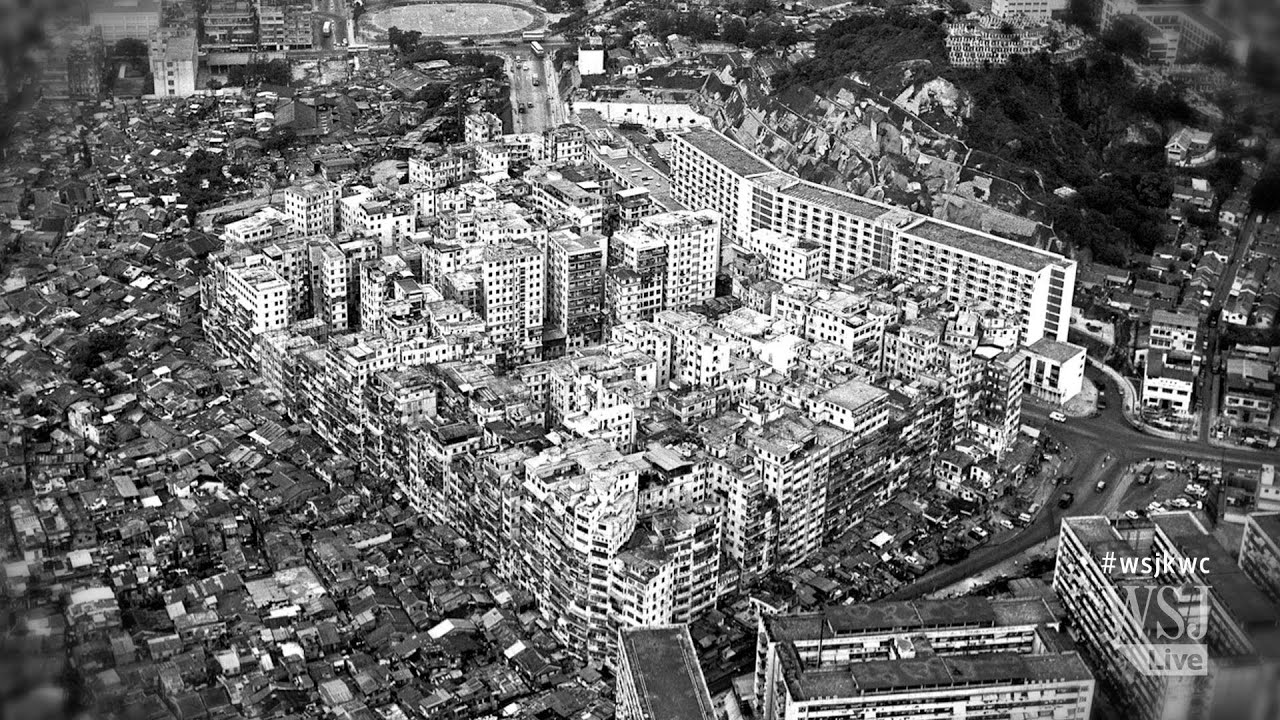
Kowloon Walled City, one thought to be the most densely populated place on earth, It was ungoverned and notorious for it's crime and drug dens. 

The city traces back to the 1600's, when it was a Chinese military fort to defend the area against pirates and to manage the production of salt, but it eventually became an enclave when the Chinese authorities leased the New territories to the British.
During World War II, Hong Kong fell under the rules of Japanese occupation, and parts of Kowloon Walled City were demolished for building materials for the nearby airport. When the Japanese finally surrendered the city, the population increased as the number of squatters moved in and made their homes there. It then fell under the rule of Chinese triads.

By the 1980's, it had become notorious for its brothels, casinos, cocaine parlors, and opium dens. It was also famous for its restaurants that would serve dog meat.
The city eventually became the focus of a diplomatic crisis, with both China and Britain refusing to take responsibility. Over time, British and Chinese authorities found the city to be increasingly intolerable, and made the decision to demolish it, despite the city's lowering crime rates over the later years. Eventually, due to lacking sanitary issues, the decision was made to demolish the city.
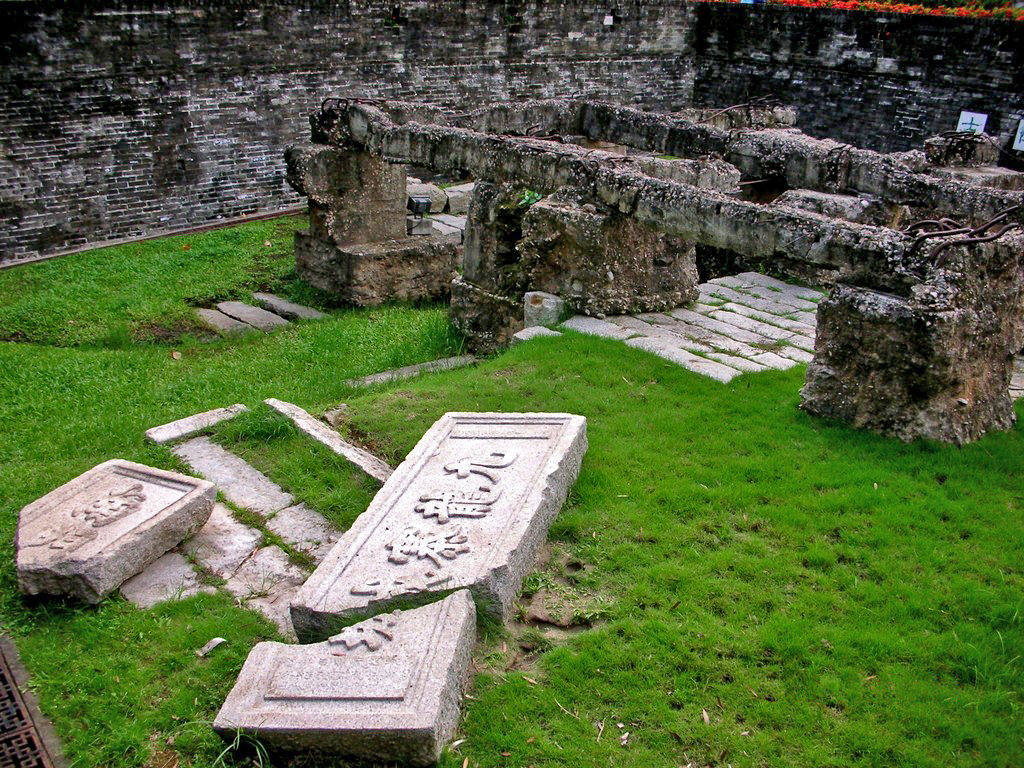
Some residents protested, but the government spend 7.2 billion HKD's in compensation and began the evacuation in 1991. The evacuation was completed in 1992, and in 1993 demolition began and finished in 1994. In 1995, Kowloon Walled City Park opened. In it were the preserved remnants of the South Gate to the City, as well as the Yamen building. 


At the peak of its population, the city was home to 33,000 people; 33,000 families and businesses were all crammed into around 300 interconnected high rise buildings, all constructed without the input of architects, within a 2.6 hectare block. The only open place were the rooftops of buildings, where planes often flew overhead because of the city's close proximity to Kai Tak Airport. despite the rate of crime in the city, the residents were said to live peaceful lives.


Hashima Island

Hashima Island


History of Hashima Island:


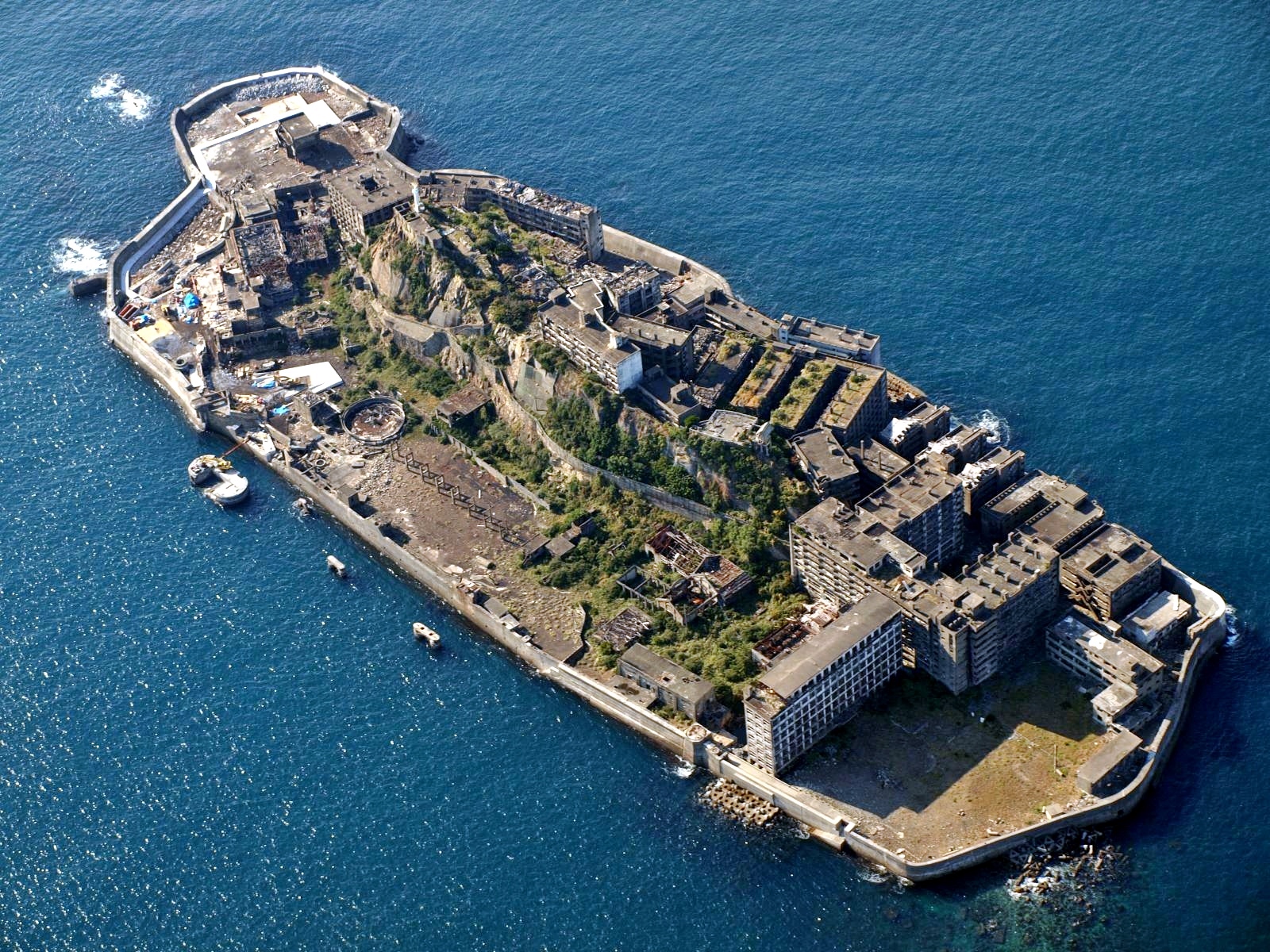
Hashima Island, commonly called Gunkanjima, and also known as Battleship Island, is a former coal mining island established in the 1880's that was most active around the end of the 1950's. It gets its name because of its likeness to the Tosa Class Battleship after the inhabitants reclaimed land from the sea surrounding the island to make it three times its original size using materials dug up when digging down to make the mining shafts. the mine was closed down in 1974, and all inhabitants were relocated.

Hashima island became a world heritage site in 2015 after a long struggle against South Korean representatives due to their refusal to acknowledge the history of forced labour on the island. South Korean representatives finally dropped the case when the Japanese agreed to acknowledge it as part of the history of the island.

Since being abandoned in 1974, the island has fallen into a state of disrepair, but for the most part it's buildings remain intact. They had been built using reinforced concrete.


Wednesday, 7 June 2017

Introducing Theory

Introducing Theory


Over the past couple of months, I have been experimenting with various things such as stability of materials and stability its self, however it became quite clear once my ideas began to run out that without theory to work from as a source of inspiration, it was going to be extremely difficult to continue working to create worthwhile pieces. 

To find an area of interest to work from that I could bring theory from, I started brainstorming what my interests were outside of art.

My interests were as follows:

  • Clouds/ Sunsets and sunrise (The ever changing nature of): I am rather fascinated by both sunrises and sunsets, but am more interested in clouds and how they are ever-changing and never the same. I like to watch how sunlight filters through or doesn't filter through, and how the shape and colour of a cloud can tell much about the cloud itself. Sunsets and sunrises are always the same, but because of the weather or how the clouds have formed in the sky, they never look the same.

  • Slums (The architecture, culture of, and community between residents): The reason slums fascinate me is because of how they spring up and expand and follow the shape of the land. They residents use materials that they find in order to build shelters and homes, and what was once a temporary home can become a permanent residence. Slums, despite first appearances, have a healthy and individual eco-system, and have their own neighbourhoods and communities. More over, the community between the people living in 'squalor' is much more wealthy that the community that resident in urban environments share. I feel there is much to learn from those who have nothing but still live happily. 

  • Drag (The exaggeration and community): Drag is something that influences everyday life without people really knowing it. It is an art form that is heavily looked down upon because of the stigma surrounding drag and homosexuality. Within drag there are numerous different categories that each have their different rules, and each city has their own drag 'family'. It is a time consuming art form that I respect. The exaggeration and transformations are what I really enjoy; A drag queen or king can use cosmetic that people use in everyday life to create a mask that looks hyper-feminine or hyper-masculine. I personally prefer drag Queens for the amount of effort and pain they choose to go through in order to create this second persona.

  • Reading (Particularly the fantasy genre wherein a whole new world is created but still relates to reality through the uses of religion, monarchy, and hierarchy): I love that no matter how different the world, and no matter what inhabits said world, the creator will always put into place a hierarchy reliant on monarchies and religion to keep the world intact and running. It is said the a hierarchy and religion is all that is needed to uphold a community, and yet it is also what can break one down.
From my brainstorming, I was able to pick out multiple different aspects of each point (not including my interest in clouds/sunsets/sunrises) that reappears in each; that would be community and rules.
Relating this to my FMP, I thought about creating a, interactive piece that would bring people together, however the issue still remains that people can still interact with the piece alone. Instead, I decided to experiment with creating my own rules that would restrict how I worked, but would also make me think outside of the box.
At first, the rules didn't help as I didn't know where to start after hastily setting myself some set rules to work by. Once I realised that working by set rules wasn't going to work, I decided instead to experiment with setting new rules each time I started a new piece. My first rules were must be symmetrical, only one batch of plaster can be used, and must include one primary and one secondary colour, however these rules, rather than allowing me to form ideas, completely stumped me.

Of course, if I could link other parts of my contextual work into my FMP, that would give me even more ideas. Out of all of the ideas that I had noted down whilst brainstorming, I was most interested in the Slums. 

Since I use a lot of found objects within my work, I thought that I could start to bring in reference materials from slums to begin to construct things or to come up with ideas.
My first idea was to simply reconstruct a model of the Mumbai super slum Dharavi, using both found and manufactured objects. The city of Mumbai would be portrayed using materials such as bricks and plaster blocks, while the slum surrounding it would be unorganised and made up of found drink bottles, cans, and plastic cups. I thought about slowly collecting bottles and the likes over time and eventually creating an extensive 'city' that would spread out across the exhibition floor, however the more I looked at it, I decided I wasn't satisfied, and there also wasn't any development work that led up to the idea, which would have made no sense. 

I decided after this that my first rule to experiment by would be Build Up, which meant that rather than creating something that would sprawl across the exhibition floor, would instead be built up towards the ceiling. At this point, I was still hung up on my former idea of experimenting with stability, so I thought about creating something that would effectively climb up a wall and would rely on the balance of the objects used to stay upright, however, after some testing with matches, I realised that it would be impractical.


It would be incredibly difficult to build up on top of a structure that wasn't held down nor held together, as when constructing it, it could collapse. 

I also tried building with jenga blocks, which in comparison are much more stable that matches, however the structures I was able to create with these blocks were nothing more than basic.


I thougth about recreating a slum house that I had seen an image of, but it just didn't feel right. I liked that the blocks were all at different levels and were unstable, but it looked too put together.


What I like the most about slums in general is how people live in the small amount of space allotted to them. 


T most, the places look extremely ugly, and to the residents of the cities that the slums are in, they are more commonly seen as an eyesore than a place that hides a wealth of things we could learn from. It is the ugliness that I really like- I love how the buildings are crooked and towered on top of other buildings, and how they loom over narrow alleys and roads.

Slums are an excellent example of how something is build up and out with limited space and resources, which is exactly what I aim to show within my work limited only to the objects I can find or create. 


Saturday, 25 February 2017

Using My Research

Pieces Inspired By Artists


After researching into artists such as Patrick Heron and Dylan Gebbia Richards, and after experimenting with one coat plaster, I thought it would be best to move away from creating sculptures that stood tall, as I found myself creating the same type of things I had been making a year previously. I wanted to experiment with creating reliefs, which meant that I could still experiment with making sculpture, just in a different manner. 

I started my new sculptures by making a flat slab of plaster using the cottling technique. This technique means that you can get smooth lines and can create a slab of any size or thickness to your liking. I chose to do this because I felt that using cardboard as a base which I had done before would get too soggy and wouldn't be strong enough to hold the amount of plaster i planned to put onto it. Whereas if I were to use a solid base made out of the same material, as long as I made a good batch of plaster, it would be strong enough to hold the weight.


Unfortunately, the first batch of plaster never set properly, and rather than letting it go to waste, I used my research into Patrick Heron, and experimented with his choice in colouring and his technique.
Heron would create abstract pieces using information of his surroundings to create resemblances of what he remembered, rather than looking at the object in front of him. So I started looking for things that were in my vicinity, but rather than paying attention to drawing them accurately, I just scratched a simple and abstract shape of the object into the plaster.

As I painted the background, I realised that I didn't really like the colour combination I had chosen, and that it didn't really turn out as planned, and rather than painting just the inside of the shape, which I felt would have been boring, I chose to use a bright yellow to stand out from the dark green and blue to draw the outline of each shape.

I used a small amount of blue to fill in circles in particular, and in any other places I felt were over powered by the yellow. I also used red to fill in most of the lines. When filling in the shapes with colour, rather than filling them in neatly, I decided to apply the paint unevenly so as to add some dimension back into the plaster.


After this, I attempted to use the cottling method again, but this time, making the plaster uneven on the surface, particularly on the corners. Thankfully, this batch of plaster set properly, and so I was able to work properly on it.
For this piece, I had been looking at an artist who created texture by adding different layers upon layers of colours. I started with a base of three colours, which were given texture by mixing the paint with sand. Each different colour had a different thickness so that they would all apply differently.


For this piece, I plan to keep building it up using different colours. The way I plan to apply the colour is by watering down paint, and spraying it from the underside of the bumps created by the mix of paint and sand, so that it will enunciate only the underside of the texture.


Monday, 6 February 2017

Study Skills

Harvard Referencing


What is Harvard Referencing?:

Harvard is a type of referencing used primarily by University students to cite information sources. Two types of citation are included:

-In-Text Citation
-Reference Listing

In-Text Citation:

In-Text citation is used when directly quoting or paraphrasing a souce. They are contained in the body of work and contain a fragment of the full citation. Depending on the source type, some Harvard referencing may look like this:
"After that I lived like a young rajah in all the captials of Europe..." (Fitzgerald, 2004)

Reference Lists:

Reference Lists are located at the end of the work and display full citations for sources used in the assignment. Example:
Fitzgerald, F. (2004), The Great Gatsby. New York; Schribner.

The reference list includes:

-Name of the Author(s)
-Year Published
-Title
-City Published
-Publisher
-Pages Used

Generally, Harvard list references contain:

Last Name, First Initial. (Year Published). Title. City: Publisher, Page(s)

Citations are listed in alphabetical order by the Authors last name. 

First and not first edition citing:

Example (First Edition):
Patterson, J. (2005). Maximum Ride. New York: Little, Brown

Example (Not First Edition):
Dahl, R. (2004). Charlie and the chocolate factory. 6th ed. New York. Knopf.

If there are multiple Authors, they are listed in the citation in the order they appear on the document. The names are separated by 'and'.

Example:
Desikan, S. and Ramesh, G. (2006). Software testing. Bangalore, India: Dorling Kindersley, p.156.

Wednesday, 23 November 2016

Going Back To My Manifesto

Stereotyping, Racism and Discrimination


While at the galleries, I was looking in particular for any pieces that reflected what I was looking at in my own artwork. There were very few, however, there were a couple of paintings that I found really interesting.


There were a couple of artists or pieces that caught my eye for the style and the colours used. 


L.S Lowry


What I liked about these pieces were the colour scheme, and the busy scene he depicted, while at the same time, it seemed a lot empty because of how the colours got paler in the background. I liked the depiction of street life and the bustle of people.


Andy Warhol


After learning about Warhol throughout school, I have grown to dislike his work, however I do like the colours that he uses. I particularly liked the pieces I saw at the Manchester Whitworth that were of two colours, and that also had glitter on them, just because I never thought it to be something that Warhol would do.


Finally, this piece related directly to my subject matter, and was extremely eye-catching, placed in the Whitworth at the top of the wall on a large scale. The colours used were very bold and stood out against the cream paint of the wall it was hung on.


Tuesday, 15 November 2016

Early Netherlandish Painter

Heironymus Bosch


Heironymus Bosch, Born Jheronimus van Aken, was born circa 1450, and died in 1516.
He was an Early Netherlandish Painter, and was known for his fantastic imagery, detailed landscapes, and illustrations of religious concepts and narratives. His pessimistic and fantastic style cast a wide inspiration on Northen 16th century art. His most acclaimed works consists of a few Triptych alterpieces, the most outstanding of which is 'The Garden of Earthly Delights'. Only around 25 paintings are confidently given to his hand, along with 8 drawings, Some of which are signed 'Jheronimus Bosch'.
Peter Bruegel the Elder was an avid follower of his.
Not much is known about Bosch, however, it is known that he remained in the town of his birth in his grandfathers house for most of his life.

The Garden of Earthly Delights


'The Garden Of earthly Delights' was painted between the years of 1490 and 1510. and has been housed in the Museo del Prado in Madrid since 1939.
It is a Triptych painted in oil on oak, and is composed of a square panel flanked by two other oaks rectangular wings. The outer wings, when closed, show a Grisaille painting of the earth during the Biblical narrative of Creation.
The left panel depics God presenting Eve to Adam, the right center panel is a broad panorama of socially engaged nude figures, fantastical animals, over-sized fruit, and hybrid stone formations. The right panel depicts a Hellscape, and the torments of damnation.
Art historians are torn over whether the center panel shows a moral warning, or a panorama of paradise lost. 

The Crucifixion of St. Julia


Another Triptych of Hieronymus Bosch's. Through Dendochronological analysis it was dated to around 1497. According to some historians, Bosch painted this while on a hot trip to Northern Italy, but it is most likely that it was commissioned by an Italian diplomat active in the Flanders.

The central panel depicts the crucifixion of a Saint usually identified with Saint Julia of Corsica, sometimes Saint Wilgefortis. The woman in the centre is elevated, balanced by a large crowd at the foot of the cross, including executioners and common people. 
The two other sides show two cities. The right panel shows a port characterised by domed buildings and several sunken ships, and the left a city on fire, occupied by demons. At the bottom are several parapets, with hermit in a dark hood, most likely Saint Anthony in meditation, and a monk and a soldier, who point at the central panel, traditionally identified as slave dealers. 

Wednesday, 12 October 2016

Visual Story Telling

Compositional Utopia


Following on from last week's task, and by using research into Mise En Scène, composition, semiotics and visual narrative, we were tasked to create a piece that was the Utopian dream of the manifesto we created. Since, for the last task, I focused more on a specific element than building on the manifesto to create a Utopia, this week, I will solely be focusing on creating a Utopia to the manifesto I created. 

The term Utopia was coined from the Greek by Sir Thomas More for his 1516 book Utopia, describing a fictional island society in the Atlantic Ocean. The word comes from the Greek ού (not) and τόπος, (place) and means "no place", and strictly describes any non-existent society "descirbed in considerable detail".

Mise en scène is the arrangement that appears in the framing - actors, lighting, décor, props, costume- is called mise en scène, a French term that means "placing on stage". The frame and camerawork can also be considered part of the mise en scène of a movie.


Composition is the term used to describe the arrangement of the visual elements in a painting or in other artwork. It is how the elements of art and design- line, shape, colour, value, texture, form and space- are organized or composed according to the principles of art and design- balance, contrast, emphasis, movement, pattern, rhythm, unity/variety- and other elements of composition, to give the painting structure and convey the intent of the artist.

Renaissance painting differed from the painting of the late Medieval period in its emphasis upon the close observation of nature, particularly within regards to human anatomy, and the application of scientific principles to the use of perspective and light. 

Linear perspective is a type of perspective used by artists in which the relative size, shape, and position of objects is determined by drawn or imaginary lines at a point on the horizon.


Rule of thirds is applied by aligning a subject with the guide lines and their intersection points, placing the horizon on the top or bottom line, or allowing linear features in the image to flow from section to section.


Golden Ratio looks very similar to the rule of thirds principle, yet it has one very important difference. Instead of dividing the fame into equal thirds of 1:1:1, the golden ratio is applied to divide the frame into sections resulting in a grid that is 1:1.618:1.


Pyramid composition is when subjects are placed within the outline of either a triangle or a pyramid.


Visual Narrative is a story told primarily through the use of visual media. The story may be told using still photography, illustration, or video, and can be enhanced with graphics, music, voice, and other audio.

Semiotics is the study of meaning making, the study of sign processes, and meaningful communication. This includes the study of signs and sign processes, (semiosis) indication, designation, likeness, analogy, allegory, metonymy, metaphor, symbolism, signification, and communication. Semiotics is closely related to the field of linguistics, which is a study of the structure and meaning of language.


Wednesday, 5 October 2016

Artist research

Sophie Taeuber-Arp


Taeuber-Arp was born in 1889, in Davos, Switzerland, and was one of the most active figures in Cabaret Voltaire, as well as many of the important movements in the pre-World War 2 art scene in Europe.
She was one of the signers of the DADA manifesto, and remained dedicated to the ideas of Dada throughout her career. She later embraced the principles of Constructivism, and became on of its most important practitioners outside of Russia.
She dedicated her career to breaking down static, artificial boundaries between genre's, and desired to break down the boundaries between applied and fine arts, and also explored the relationship between fine art and performance, working with dance, movement and masks.
Her work, whether it be a Marionette, a dancer's movement, or a textile pattern, presented the possibility of crafting a more beautiful world from the elements of the present one.


DaDa Head
1920


Artist research

Cornelia Parker


Cornelia Parker is a British sculptor and installation artist. Her early installations were imbued with poetic innuendos linked to the fragility of human experience. She not only worked with scale and substance of things, but also the meaning conveyed by using found objects.
She is best known for her large scale installations such "as Cold Dark Matter: An Exploded View" - 1991
In 1997, she was short-listed for the Turner Prize

Cold Dark Matter: An Exploded View
1991
"Cold Dark Matter: An Exploded View" was a piece created after Parker herself pressed the button that detonated and blew up a shed she had taken to the Banbury Army School of Ammunition. The point of hanging it was to rob it of its pathos, and also reanimated the pieces.

Mass (Cold Dark Matter)
1997
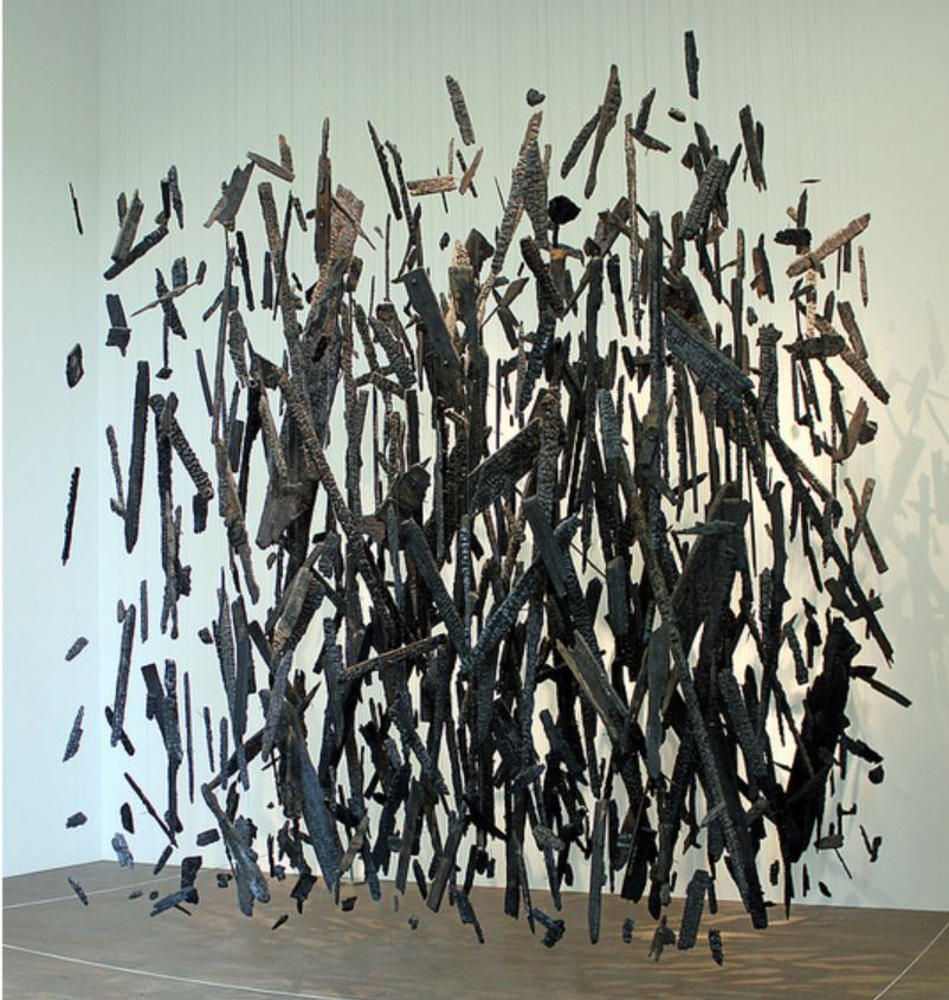
Mass (Cold Dark Matter) was exhibited at the 1997 Turner Prize exhibition, and was an arrangement of the charred remains of a church that had been struck by lightning in Texas, in the visual form of a suspended cube.

Anti-Mass
2005
Anti-Mass was the companion piece to Mass (Cold Dark Matter) and was made using charcoal from a black congregation church in Alabama, which had been destroyed by Arson.

Artist Research

René Magritte


René Magritte was born in 1898 in Lessines, Beligium, and was a pioneer in Psychoanalysis and one of the key figures in the Surrealist movement.
He started his art career as a commercial artist, and by producing book designs to support himself. While some French Surrealists preferred the lavish and ostentatious lifestyles, Magritte preferred the quaint anonymity of a middle class existence, and while a lot of French Surrealists were experimenting with new techniques, Magritte adopted the deadpan, illustrative technique that clearly articulated the content of his pictures.

The illustrative quality of Magrittes pictures often results in a powerful paradox: Images that are beautiful in their clarity and simplicity, but which also provoke unsettling thought. They seem to declare that they hide no mystery and yet they are also very strange.

The men in bowler hats that often appear in Magritte's pictures can be interpreted as self portraits, and he often portrayed his wife, Georgette, as well. These portraits of him and his wife, as well as the images depicting his apartment could suggest autobiographical content, however, it more likely points to the commonplace sources of inspiration- It as if he believed that we need not look far for the mysterious, since it lurks everywhere in the most conventional of lives.

Magritte was fascinated by the interactions of textual and visual signs, and some of his most famous pieces employ both words and imagery. Conceptual artists have admired his use of text in images.

In later years, Magritte was castigated by his peers for some of his strategies, such as his tendency to produce multiple copies of his works.

The Son of Man
1946
The Treachery of Images
1929
Empire of Light
1953 - 1954