Showing posts with label Experiments. Show all posts

Monday, 19 June 2017

Introducing Theory

Avoiding patronisation and development of theory topic


I had rebooted my project with the intention of using slums as the base as I am really fascinated by the architecture and lifestyle within these areas. However, it was pointed out to me that while it most certainly wasn't my intention, looking at slums as a source of fascination was dancing on a very thin line between fascination and patronisation. I was also in danger of making blatant representations of the mismatched buildings seen in slums for lack of direction to take the idea.

It could be seen as patronising because I would be looking at the lifestyle of a person who lived in that situation and seeing it as interesting, whereas circumstances in the areas I would be looking upon with interest have no choice but to live their. It is a necessity rather than a choice they made.

Because I would be assuming how the people living in slums felt about living in the slums, it was suggested to me to instead look at the topic in terms of animals so as to remove from human condition, and rather than look at the architecture itself, perhaps look at structures made through necessity and instinct, like anthills and termite mounds.
Within the mounds made by these insects are extremely interesting structures made my animals born into a hierarchy; a worker ant is born a worker ant, a queen ant is born a queen ant. It is easier to assume that ants and termites don't think about their position in their hierarchy because we aren't the same species, and cannot communicate.

From here, is started looking at Animal Far, a book written by George Orwell and first published in England in 1945. The book depicts a social hierarchy within a group of farm animals with pigs being the highest on the food chain. It is an allegorical story, and tells from the perspective of animals the lead up to the Russian Revolution in 1917l, and then to the Stalinist era of the soviet union. From this book, a became very interested in the quote:

"All animals are equal, but some are more equal than others."

This quote to me became the basis of my new investigation and experimentation. I started out with the most basic of ideas; the materials I use should be of equal amounts but of different value.

I began to break down the quote into what it could mean.


while the meaning is very obvious, I wanted to see if it could hold any other meanings that could be of use to me when experimenting, but in the end, I decided to settle with the most obvious of meanings, which al comes back to hierarchy; There is no equality, only hierarchy.

My project would be focused on creating an allegorical sculpture or installation that depicts the quote, which I had reformatted to 'everyone os equal, but some are more equal than others'. I planned to depict how those higher in the food chain would say that 'we're all equal', but would live more luxurious lifestyles than most.

The piece would be made using very raw materials, as I had done throughout the project, and would comprise of towers of different heights that all held the same material on the top, which would be plaster. 


Tuesday, 23 May 2017

Stability

Purposefully making objects unstable


After experimenting with destroying stability in sand, I decided to combine both sand and plaster together, but not mixed, to make a sculpture that would crumble when I forced it to.

My idea relied on the knowledge that sand crumbles straight away or over time when water is introduced depending on how it is introduced because of a previous experiment, and also relied on the knowledge that plaster would crumble but at a slower rate because of a different experiment.

My focus for this experiment was getting a shape or layout that would work best, and where the sand could be easily reached by water. Each idea I had would always have sand as the base piece.

at first, I decided to build a tower using alternating layers of sand and plaster, but after some thought, i realised that only the bottom would crumble while the rest of the tower was like to remain stable. I chose to use triangle blocks instead, which would mean that I would have to stack up the different sized and shapes triangles into an unstable position before the experiment had even started. I planned to sit the tower in water and let it fall as the base crumbled.

I then decided to make the plaster piece larger so that it could topple over when placed on the sand triangles, which were all one size because of the trouble  had moulding them. The difference in size meant that they would either be balanced, or the top would overbalance the bottom and would be unstable.


Out of curiosity, I decided to try it with a sphere of plaster rather than another triangle.


The sand triangles I had moulded a week before, but because of the environment they were in it took them around about a wek to dry fully before I could use them.

Mixing Sand into Plaster

Making curves with plaster


Since I had started moving back into my comfort zone, I decided to try and mix other materials into plaster to see what would happen.
I also decided that rather than making simple lumps of plaster,  wanted to make a shape that would actually curve.

At first, I had planned to create two different lumps of plaster and join them together by a found object, inspired by an earlier experiment I had done where I had used the plaster as a plinth for a found object, rather than using a plinth to present plaster.


While it isn't clear in the image, the plaster does in fact bend where one of the pedal cranks comes out from the gear wheel and down. I wanted to try and make an arch with plaster without having the support of something running through it. Of course I was aware that I would have to build on it slowly and in pieces because it would be impossible to make the shape all at once. I also decided to add in some scrim for texture, and also to add some support where I would be joining the plaster together during the building process.


I started by covering an old experiment in plastr mixed with clay, but as I had poured red ink over the plaster in the previous experiment it began to sink through the new plaster in places. I decided to make an entirely new base and start from there.


Building it up was the easiest part, as it didn't really need any support like it would at the curve. All i did was bring some of the new plaster down to the old to blur the gap between the two parts.


The newer base that I had started turned out to be too round, so I chipped away some of the plaster to try ad reshape it, but in the end I decided to start again, and chipped away all but the bottom of this lump. Once I had built it u again to a shape I was happy with, I knocked my found object into it (a construction support) and added a ball of scrim on the top of the support so that I could add plaster over it later.

After that,  began to build the curve on top of the plaster lump. At first it was quite easy, as it was still slightly vertical, but as the curve flattened out, it got harder to keep the plaster onto the end of the curve, especially since my plaster mixes varied in consistency.


After reaching the mid point of my curve, I decided to leave it and work on it another day. I had built on top of the construction support as well, which I had to wedge into place so that it wouldn't fall. I left it because I wasn't sure I wanted to join the two pieces together. I liked the idea of having a solid arch made of plaster better than having an arch joined by a found object.


After coming back from the weekend, I found that the arch had collapsed into four different pieces. It was obvious that they had split where I had added onto the previous plaster batch, and each varied in size. The main cause of it collapsing was probably because the plaster hadn't set at all since making it, and even felt more damp than before I left it. I can only assume that this was because I added sand into the plaster when making it.


 I find these four pieces quite interesting, as they are remanents of what was, and fully demonstrate my project theme of the ever-changing and stability within objects. Though this wasn't a case of setting myself up for purposeful failure, it coincidentally fits in, and also will enable me to build on that side of experimentation.


Wednesday, 17 May 2017

Playing With Sand

Playing with Sand


After considering what I should do after falling into a slump, I spent a long while just looking at my work. I had thought about looking at other materials to use that didn't fit into my category of unstable, but would still fit in with the theme of change. I thought about plastic bags, which look stable, but slowly disintegrate over time. I realised however that I didn't want to create a solid piece of work. I thought about creating a piece that represented change, rather that making something that would actually change over time, as that would enable me to continue experimenting with plaster. I wanted to challenge myself however, and decided to experiment some more with sand. 
I also decided that rather than trying to make a structure using unstable materials work, I would experiment with setting myself up for guaranteed failure.


Before this decision, and as part of a previous experiment to see how well sand would hold up when plaster was poured over it, I made a small piece using sand from an experiment before this. The sand had hardened, but from other experiments, I know that when moisture was introduced it was quick to fall apart. When I poured plaster over it, I found that nothing much changed, but you could see where the moisture had started to sink into the sand underneath.
I tried chipping out the sand so that I would be left with a shell of where the sand had been, but it had dried solid. While it did crumble away when dusted, I had trouble trying to chip it out of the plaster using a fork, so I left the sand in.

Out of curiosity, I decided to add on top of this experiment with more sand. It was awkward trying to get the sand stick to the surface, but it stayed eventually


Following my decision to make something that was bound to fail, I came up with the idea of making a tower using both plaster and sand, and introducing elements that would force the tower to crumble. My first idea with this was to simply pile the plaster and and on top, but then I realised that even if the sand was to crumble, there might not be as much change as predicted because it was a structurally sound object. I thought about changing the shape so that the structure would rely on the bottom segment to stay upright. Using wedges would mean that the structure would no longer be as strong because the plaster wouldn't have the chance to set over the sand, and none of the shapes would be the same either, so the tower could begin to lean unpredictably as it was being built. 

I would purposefully put a sand wedge at the bottom of the tower, as I know that it crumbles quicker than plaster, and sit it in, or introduce, water. If the bottom wedge was to crumble, the tower would undoubtedly fall. 

I had also built another tower using sand the day before, and didn't want to leave it to dry fully, as it would defeat the purpose of experimenting with unsound structures and materials.


As I was building the tower, it became increasingly difficult to keep the tower straight without breaking it, and I had to build it up using small amounts of sand so that it wouldn't crumble from the pressure I would have to apply to push it onto the tower. As a result, the tower was a lot looser at the top than the bottom, and was therefore more liable to fall is forced to.
I had the idea of pushing things into the sand until it fell, like a lot of children's games such as jenga and pop-up pirate. I thought it would be best to use twigs to do this, as it would be in-keeping with the theme of ever-changing I conducted the experiment twice.

In this experiment, I was purposefully looking for weak places in the sand tower, and pushing in the twigs until it fell.


I think that the most interesting part of this experiment was the result. The base of the sand tower in both cases remained standing, and the twigs protruding from what remained at different angles was interesting to look at.

From here, I plan to continue playing with the fragility of a material in order to bring about change.


Tuesday, 16 May 2017

Plaster and Found Objects

Experimenting with plaster and found objects


As the end of FMP draws nearer, I find myself struggling for ideas. Out of habit, I have once again moved back to experimenting with plaster no that I have gotten it to work, and have begun moving away from my experiment with stability. 
Realising this, I made a feeble attempt to join the two back together by mixing both the plaster and another material together. Needless to say, it hasn't brought forth any new ideas about where to take my work.


I feel as thought I am trying too hard to incorporate too many things into my work, but keep finding myself moving back to the same things. My experiments with new materials so far have led me nowhere in terms of development. I find myself falling back into a routine of doing what I had been doing for my previous FMP.
Though I am considering it to be a negative thing, it is possible that it is what I need to progress further within my work, and is necessary for my to revisit what I have done so that I can push myself to look at new things. 
I also find myself moving away from my theme of change and evolution, and while it is a vague concept that can be interpreted in very many ways, I feel that the work I am producing at the moment isn't contributing to the theme at all.

I feel panicked because of the small amount of time we have left on the project, and feel pressured to keep producing work to build up the experiments to I have something to be graded by.

For now, I feel it would be best to take a step back and fully consider what I want to do with the theme, and whether using all f the new materials I have been playing with is necessary to include in my work, or whether I should keep it in mind and consider experimenting with the material I am most comfortable with.

New Materials and Scrim

Testing Flexibility of Materials


Currently, I am experimenting with the flexibility of the materials I have chosen to use in order to determine where my experimentation will develop to next. 
I decided that the best way to test the flexibility of the material was to test it on another flexible material.
Scrim was the material I chose to use because of how it is made up. Rather than being a strong material, the different strands that make up the net like form are very loose and can be pulled apart very easily. this means that even when coated in plaster, the material will still move below.


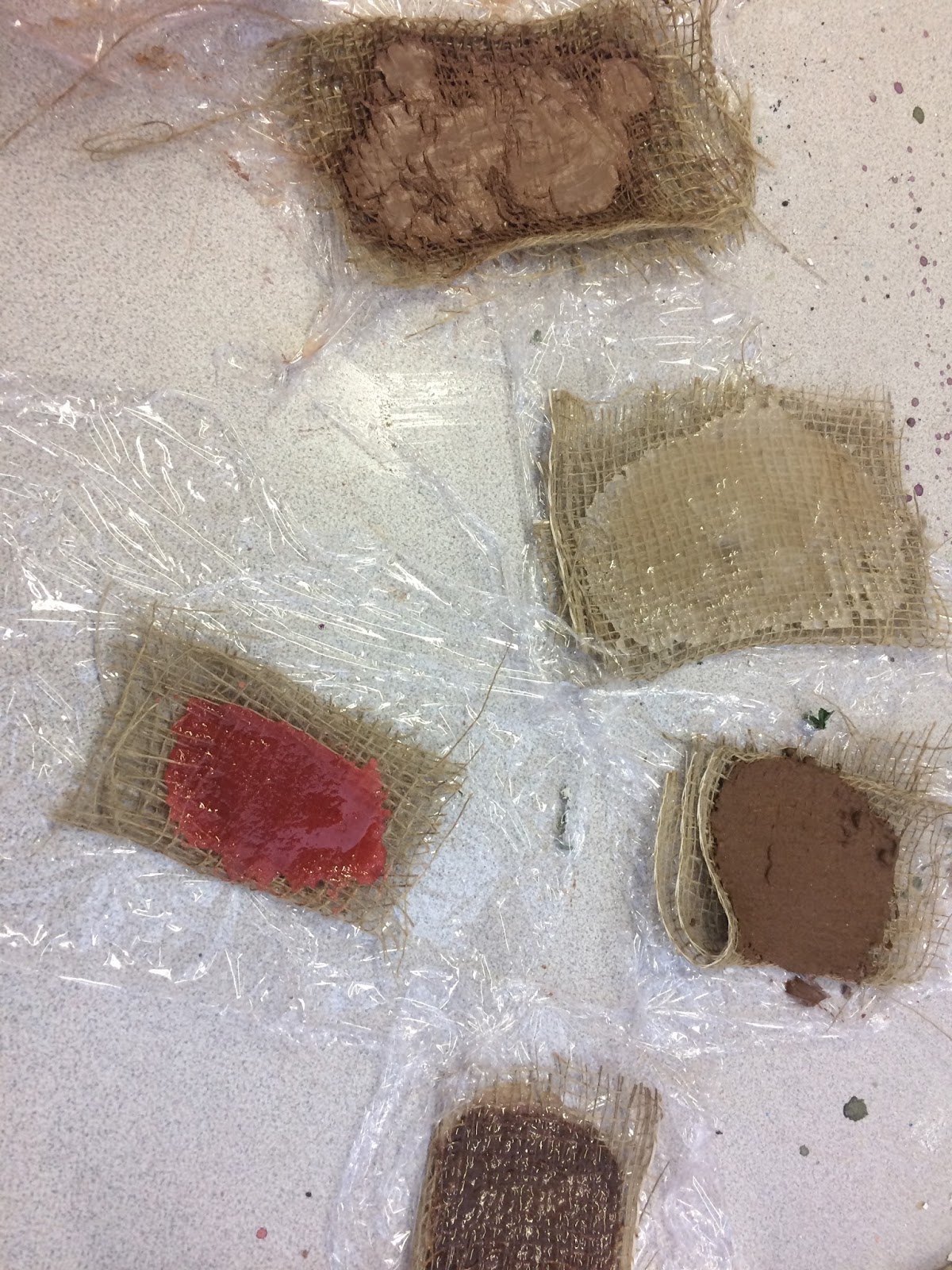
The first material I tested was a mix of sugar and water. I mixed it so that it wasn't to dry or wet,but just in the middle where the granules would make a thick liquid. I applied it in a thin layer and spread it across evenly and left it to dry.


The next material I chose to use was sand. I had doubts about this material already, knowing that it could be knocked loose very easily when dry, and was probably the most like to crumble when tested.


I added small amounts of water until it was the desired consistency, similar to the sugar and water mix, and then applied it to the scrim. 
In comparison to the sugar and water mix, the sand didn't apply as smoothly to the scrim, and would easily pull up if spread to thin.
I also made another mix using both the sand and the sugar and water mix together.The colour it produced was a lot darker than that of just the sand alone, and it also took the longest to dry.
One of the to sand experiments I made was put outside to dry, while the other was left ith the rest inside.


I also mixed ink and the sugar/ water ix together to see if it would affect the drying time. It didn't.


Finally, the last material I tested was clay, knowing that when it dried without the proper conditions it would crack. I put this experiment outside to dry because otherwise it would have taken a long time.


My conclusions from this experiment:


  • Sand: The outside experiment dried quick but as predicted would flake off and crumble when the scrim was bent and moved. The inside experiment took a lot longer to dry, but would already crack and crumble when moved.
  • Clay: Dried quick because it was outside. It had surprising flexibility because it had been pressed into the strands of the scrim. when the scrim was bent it would crack, but it didn't crumble off of the scrim.
  • Sugar/ Water mix: Dried the quickest despite its appearance, which was wholly unchanged. When the scrim as bent, it would flake off, and took on a crystalized form. 
  • Sugar/Water + Sand: Colour of the sand became darker when added to the sugar/water mix. Took the longest to dry.

Experimenting With Materials

Experimenting with foods


Following my experiments with sand, and still following the idea o using materials similar in physicality with the pottery plaster that didn't set, I decided to experiment with cereals, knowing that when left to absorb moisture, they would go soggy, and would later set and go hard. I was most interested in working ith the material at the stage where it absorbed the moisture I would apply to it.

The cereal I chose to use was Rice Krispies, knowing that when soggy, the cereal retained its shape. I used a small amount of water and ink for colour and mixed them together until the liquids were absorbed.
As well as being soggy, the cereal was also sticky, and would retain its shape when pushed into forms, making it perfect for moulding with


The first thing I did with the cereal was make a ball, simply to see if the cereal would hold together after a length of time or, like the sand from the previous experiment, fall to pieces once dry. I encased it in plaster so that if the shape were to crumble, there would be a visible trace of where it had previously been.

I left the cereal for around a week after this, and when I came back to it, it was covered in a thin layer of green mould. The ink had also began to spread through the plaster.
Unfortunately, because of health and safety, I had to throw the experiment in case anything were to happen because of the spores that could possibly be released from the mould.


For my next experiment, I decided to use a mixture of water mixed with sugar. This mixture would be extremely sticky, and I had the hopes that it could be used as a glue. 

I had first tested it on scrim to see what would happen if it were applied to a flexible surface.


I had believed that the mixture would take a while to set, and as the day went on my suspicions grew. There had been no visible change to the appearance of the experiment. It still looked as glossy and wet as when I first applied it, but when I went to touch it, the sugar and water mixture had gone solid, and had formed a thick crust over the scrim.

At this point, I found myself lacking for ideas, and had begun experimenting with the pottery plaster again. Because I had finally figured out how to get it to set solid, I had started to move back to my comfort zone. I had also started picking up found objects once again because of my lack of ideas, and had started combining the two together. Realising this, I decided to add in some of the new materials I had been experimenting with. 


At first, I had considered painting the entire experiment in one block colour except for the found object, in this case the glasses, but instead decided to combine ink with the sugar water mix I had been experimenting with, and pour it over the top, knowing that the red pigments would transfer into the plaster from the ink.


Once dry, the sugar frmed a crust similar to that as on the scrim, but because the surface was uneven and more textured, the sugar had began to flack off in places, and had stuck in others.
The colour had faded a whole lot since I had applied the mixture to the plaster, but the way the pigment had spread from where it had initially been was interesting.


Friday, 28 April 2017

Experimenting With New Materials

Playing With Sand


Since the pottery plaster I had been experimenting with doesn't set, I started looking towards other materials, or potentially purposefully using the pottery plaster and utilising its nature. I liked that a material known for its solidity had become unstable, and decided to experiment with other materials that were similar in nature and that could be built with. 

I looked at using clay, another material known for its structural integrity, but rathe than letting it dry solid, I looked at forcing it in fragility, knowing that letting it air dry would make it crack.

I decided to lay clay overtop of a wire armature of a leaf with the hopes that it would eventually crack and crumble off to reveal the wire structure beneath. 


It was a very rough and quick experiment, but would serve to help determine if I wanted to continue with the material. I added simple designs on the outside just so that it was more obvious that it was a leaf.

When it had dried, it had begin to crack. Unfortunately, however, it hadn't cracked as much as I had thought it would, and it also held on to the wire quite well. I feel if I were to conduct a similar experiment using this method again I would need to make the wire structure and have more gaps on it.


After my experiments with clay, I decided to try using sand, with the idea of creating a structure using the sand that would support something on top. Sand is a notoriously unstable material, so I was interested to see whether it would hold up after it had begin to dry, or if it would simply crumble.


My work for this project, while still focusing on the change of materials, now focuses on how the type of material used can inflict change on the piece. In this case, I would be using something that had a very unstable structure and is extremely likely to change as the materials state changes, in the case of this experiment, as the sand would dry.

I started off with damp sand that had been soften so as to get any big lumps out of the mixture. While I am observing the change of the material, I wanted it to be a fair experiment without things that could compromise the materials stability.


I damped the sand just enough so that it would hold together when I squeezed it in my hands. If it were too dry, it would crumble too easily and would be hard to build with, and if it were too damp, the water content would make it difficult to work with and maintain structure. 

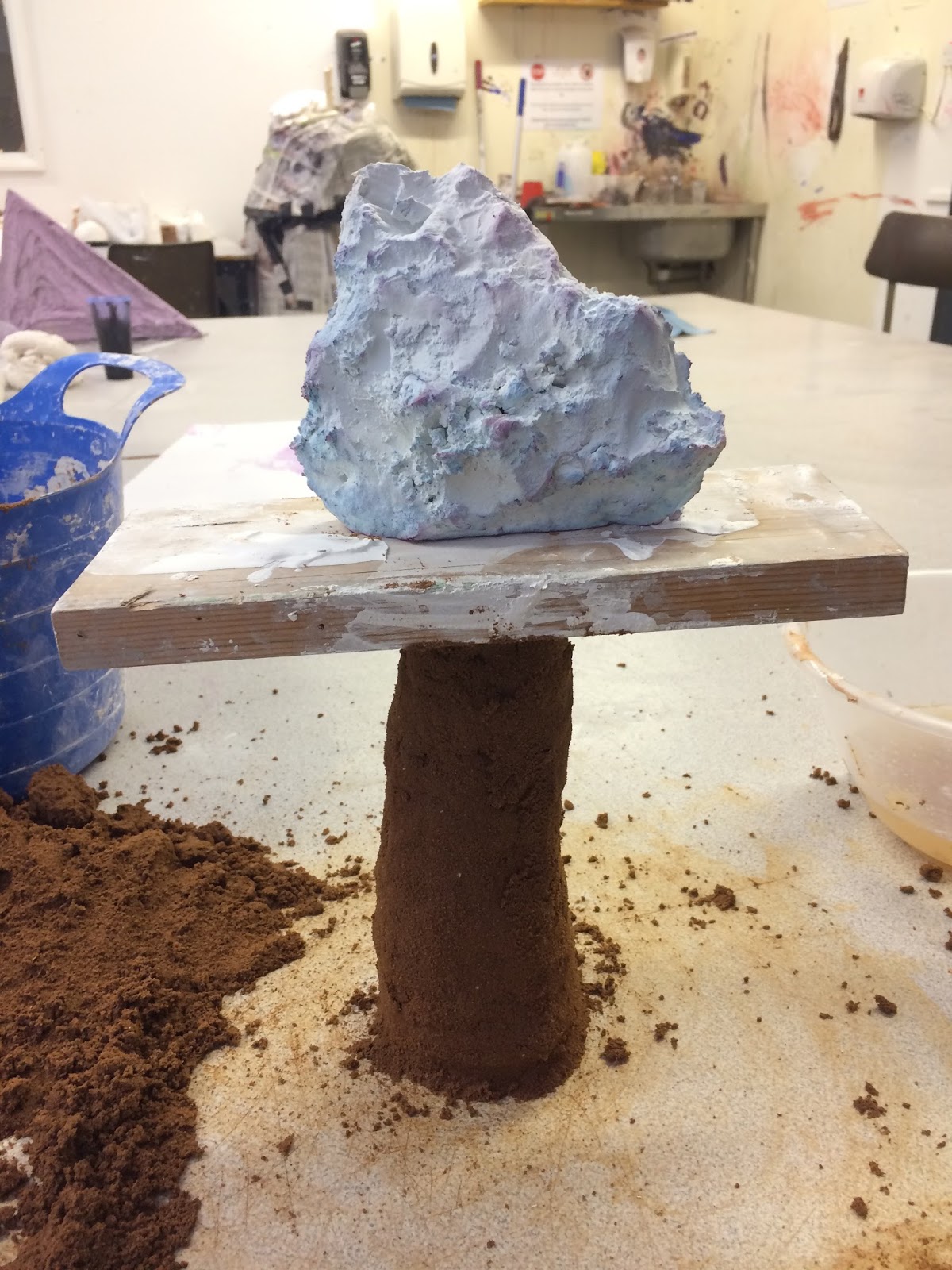
The sand as relatively easy to work with as long as not too much pressure was applied, and as long as it didn't build too high. It may have worked if I were careful, but as I built the sand up, the column became thinner and thinner.


Also, if i lost concentration on what I was going, I was like to apply too much pressure and knock it over. While building it, the sand collapsed a total of three times until I was able to get it to a hight I was happy with.
Once I had got the sand to how I wanted, I then laid a wooden plank over the top carefully, so as not to knock it over. This would enable me to put something on top of the sand while distributing the pressure. In future experiments, I plan to place an object directly onto the sand.


The object I put on top was one f my previous experiments with pottery plaster. Because it hadn't set properly, it was heavier than it usually would be, but the flat side it had on it meant that I could stand it up in the wooden plank. I placed it in the male of the plank where the sand column was so that there was less chance of the wooden plank falling off.


After this, I decided to test out some research I had done into the Japanese art form known as Hikaru Dorodango. While I knew there was a limited chance that it could work considering I was using sand instead of dirt, I decided to try it anyway.

Using the damp sand, I just moulded it into a ball and then patted layers of dry sand over the surface to strengthen it so that it wouldn't crumble. And then I left it to dry


I made another ball using this technique to see how water affected it when applied o the sad in different ways. At first, I stood the sand ball in a thin layer of water to see if it would crumble as it absorbed the water. While it did start to absorb the water, the process was taking much too long, but would be good in the future to experiment with. 
It would be a good idea for an exhibition piece to stand a sand object in water and let it slowly absorb and crumble and then build it up again.

The second technique I tried was pouring water over the top. This caused the sand to fall apart almost instantly.


I then tried applying water to it in small amounts using a syringe. Interestingly, this did wash away some sand where the water ran down the sand ball, and created small ridges.


When water was applied slowly using the method, it was create small pathways on the surface, but when applied quickly, it would knock away a large crater in the surface. The more water added, the more the sand would fall apart until it eventually split. Out of interest, I decided to see if I could create a hole running through the sand ball using this technique.


I like using this material because it gives me plenty of options and experiments to conduct. It has also fuelled my curiosity into combining stable and unstable materials together to create a piece or experiment that gets destroyed as it is made. or maybe even to preserve solid or non solid materials in solid or non solid shells. I am also going to begin experimenting with materials that go from being liquids to gels, like cornflour, gelatine and mouses.